
Where BOP Releases Go
The Federal Bureau of Prisons administers federal sentenced custody nationwide. A person can leave BOP custody at sentence completion, through an authorized release program, or by movement to another authority. A result marked released means the person is no longer held by BOP on the displayed date. It does not say that all federal obligations ended. A term of supervised release can continue in the community, and a state, local, immigration, or other federal authority may assume custody.
Calhoun County’s jail system is not another entrance to the BOP database. If the county released detail shows transfer to a federal authority, preserve that wording. The movement ends that county booking but may begin federal custody. Follow the named receiving agency and the federal case rather than treating the Calhoun event as a street release.
Confirm a BOP Release
Open the official BOP Inmate Locator. The database covers federal inmates released after 1982. Search by a BOP register number when available. The number route also accepts DCDC, FBI, or INS identifiers. A name search allows optional race, age, and sex fields, which can help separate similar results.
- Confirm that the person entered BOP sentenced custody rather than remaining solely in USMS pretrial custody.
- Search by register number, or use the exact name with only supported identity filters.
- Compare the name, register number, age, race, and sex before relying on a row.
- Read the Release Date and Location together. A past date with no institution location indicates departure from BOP custody.
- Check the federal court record for the judgment and any supervised-release term or later order.
- If another authority received the person, continue with that custodian’s official channel.
A BOP row is strong evidence for the event it reports, but it is narrow. The locator is not the Southern District court docket and does not replace the judgment. It also does not establish what happened in an earlier Calhoun County jail booking.
Read Federal Release Results
BOP results show Name, Register Number, Age, Race, Sex, Release Date, and Location. A past date paired with released status or no prison location ordinarily identifies the end of BOP custody. A future date is projected and may change. First Step Act calculations and other sentence-credit work can alter a displayed date. `UNKNOWN` means the term or release date has not been determined. `IN TRANSIT` can describe movement under USMS authority and is not a community-release label.
| BOP display | Careful reading |
|---|---|
| Past date / Released | The person left BOP custody on the shown date. |
| Future Release Date | A projected date, subject to lawful recalculation and processing. |
| IN TRANSIT | Federal movement, often involving USMS; not proof of community release. |
| UNKNOWN | BOP has not determined the term or release date. |
| No result | Check identifiers, pre-1982 archives, pretrial-only custody, and the court docket. |
Record the exact status and access date. Do not convert federal database labels into claims about the outcome of the prosecution. The judgment, later orders, and docket explain the case; the locator explains BOP custody.
Calhoun Federal Custody Sequence
A federal case can take several paths. A person arrested locally may be housed in a county facility under an arrangement while USMS controls the federal detention decision and transport. A federal judge can order pretrial release, detention, or conditions. If convicted and committed, the person may later enter BOP custody. That later prison history is the point at which the BOP locator becomes useful.
Start with the custody type, not merely the word “federal.” If the person was released before trial, locate the Southern District of Texas order and confirm with the relevant custodian. If the person served a federal sentence after 1982, use BOP. If ICE took custody, use the immigration route. The Southern District USMS page explains the pretrial and transport path.
BOP Records Beyond the Locator
For a historical federal prison record, ask the Bureau of Prisons through its official records or FOIA process for the specific custody and release document. Give the full name, register number, and an approximate date range. Ask for the admission, release, transfer, or sentence-computation record that answers the question. A narrow request is easier to route than a request for every record about a person.
Pre-1982 federal prison records may require the National Archives. The BOP locator’s date scope means no result for an older federal episode is not evidence that the person was never incarcerated. Likewise, a no-result can arise when a person was held pretrial by USMS but never entered BOP sentenced custody.
Federal Bureau of Prisons
Primary route: BOP Inmate Locator
Coverage: federal prisoners released after 1982
Search keys: register number, DCDC, FBI, INS, or name
Older records: National Archives as appropriate
Federal Release and Supervision
Federal supervised release is ordered by the court and generally follows imprisonment. It is not BOP incarceration. A BOP release date can coexist with years of court-ordered supervision, and the federal docket may later include modification, revocation, or discharge activity. Read the judgment and later orders instead of assuming released status means the entire sentence is complete.
Another sovereign can also take custody on the same day BOP custody ends. A state detainer, immigration matter, or pending local case may produce a direct transfer. Ask for the destination or receiving agency when the sequence is unclear. No single locator can exclude every other jurisdiction.
When ICE Follows BOP Release
Federal prison release and immigration release are separate events. If ICE assumes custody when BOP releases a person, the BOP date records the end of federal criminal imprisonment, not arrival in the community. ICE’s Online Detainee Locator may show current immigration custody and, under current resource guidance, some recent ICE releases. Its absence results remain inconclusive because exclusions and delays apply.
Keep a small event timeline with the BOP date, any receiving agency, the ICE custody result, and any later ICE release date. This prevents two federal systems from being treated as one. It also preserves the distinction required by the Calhoun County transfer record.
View the BOP Locator
The official BOP locator displays the identifier and name search routes used for a federal release check.
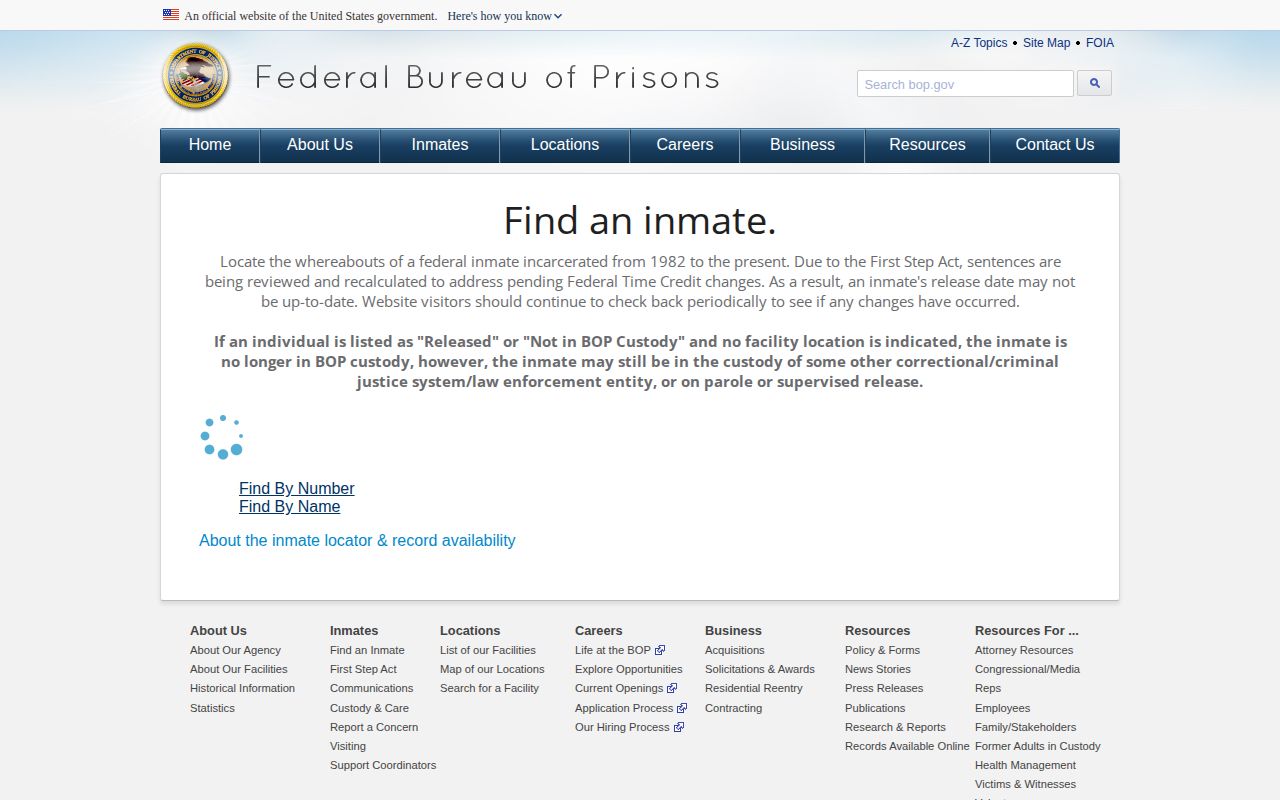
The form’s federal scope is why Calhoun County jail and USMS pretrial events require their own records.