
Calhoun Parole and Probation Paths
Parole follows a Texas prison sentence. The Texas Board of Pardons and Paroles decides whether an eligible prisoner may leave confinement under conditions, while the TDCJ Parole Division supervises a person released on parole or mandatory supervision. Mandatory supervision is a statutory release route for eligible prisoners. It is not the same as parole, even though the Parole Division supervises both groups outside prison.
Probation, called community supervision in Texas law, comes from a court. For Calhoun cases, the locally relevant route is the 24th Judicial District Community Supervision and Corrections Department, or CSCD. A court may order ordinary probation, deferred adjudication, a modification, revocation, or discharge. The Calhoun court docket is the lasting record of those actions. Bonding out of the Adult Detention Center does not itself create parole or probation.
| Feature | Parole or mandatory supervision | Probation or community supervision |
|---|---|---|
| Starting point | Release from a TDCJ prison sentence | Order entered in a criminal court |
| Decision source | Texas Board of Pardons and Paroles and governing law | Sentencing court |
| Supervising source | TDCJ Parole Division | 24th Judicial District CSCD |
| Best verification | TDCJ IVSS, Board status, Parole Division, or a TDCJ record | Calhoun court docket, signed order, and CSCD confirmation |
| End record | Parole, mandatory-supervision, or sentence discharge record | Court discharge or termination order |
Verify Calhoun Post-Release Supervision
Start with the custody system that imposed the supervision. Names alone can produce false matches, so use a SID, TDCJ number, docket number, or exact birth date when it is lawfully available. A county release timestamp identifies the end of one jail episode. It does not state whether a state sentence or a court supervision term continues.
- Check the Calhoun released detail and note the docket number, court type, confining agency, how released, and release reason.
- For a state-prison path, search TDCJ IVSS by name, SID, or current TDCJ number. Open View Details for the matching record.
- Review Board of Pardons and Paroles information if parole review or a vote matters. Eligibility is not approval, and approval is not physical release.
- For probation, search the Calhoun criminal and civil portal. Use a docket number when possible and read the chronological orders.
- Ask the assigned Parole Division office or the 24th Judicial District CSCD to confirm a status that is not clear online. Request the specific supervision or discharge record.
Calhoun Supervision Office Routes
Calhoun County falls within the Victoria-area service pattern, but TDCJ reporting assignments can change. The current TDCJ Parole Division directory should be checked before relying on an office address. TDCJ Victim Services can also help with IVSS and state custody or supervision notices. The local probation route appears in the county's law-enforcement directory as the 24th Judicial District CSCD.
TDCJ Victim Services and IVSS
8712 Shoal Creek Blvd., Suite 265
Austin, TX 78757-6899
Phone: 800-848-4284
Email: victim.svc@tdcj.texas.gov
The state contact can address notification and state-system information, but it does not replace the local court record for Calhoun probation. Likewise, the CSCD does not decide state parole. Ask each office only for the record it owns. That division avoids a common error in which a county bond release is mistaken for a parole event.
For a court case, County Court at Law No. 1 handles its misdemeanor jurisdiction while felony matters route through the District Clerk and district court. A partial name can be searched in the Tyler portal by adding an asterisk and using Last Name, First Name. A docket number from the jail detail is more precise.
Note: Verify the assigned reporting office from the live TDCJ directory because a supervision location can change after release.
Calhoun Parole Decisions and Status
Texas generally uses file review rather than a public, in-person hearing for each parole case. Institutional parole staff identify eligible cases, interview the prisoner, prepare a summary, and send the file to a Board panel. Three panel members vote in sequence, and two matching votes decide the result. A denial can set a future review date. An approval may require treatment, programming, a residence plan, or special conditions before release processing is complete.
The Board parole-review explanation describes that process, while the decision result glossary explains vote language. A favorable result is not an actual release record. Detainers, required programs, records audits, and plan approval can remain unresolved after a vote.
The public TDCJ inmate search has another limit. It is designed for people currently incarcerated in TDCJ. Once a person leaves prison for parole or fully discharges, an ordinary result may disappear. Use TDCJ IVSS, the Parole Division, Board status, or an official TDCJ response instead of treating a no-result as proof that supervision ended.
The official Board and IVSS pages are visible in the captured research materials. The TDCJ IVSS search help explains identifier searches and the View Details route.
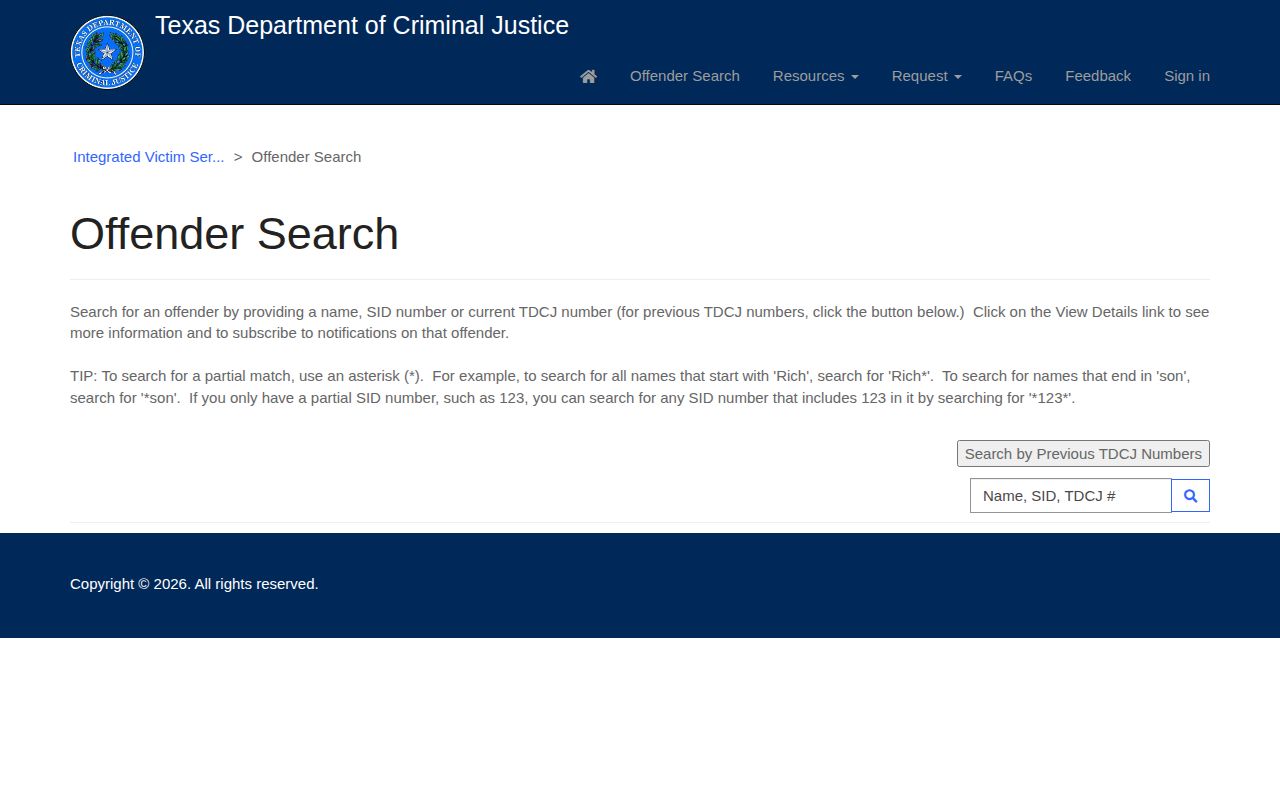
This interface is the state post-release information path, not a substitute for a certified parole or discharge record.
Calhoun Warrants and Absconders
An absconder is a person alleged to have stopped reporting or left supervision without permission. A violation can lead to a warrant, hearing, modification, revocation, or return to custody, but the result depends on the governing order and agency action. An arrest or allegation alone does not establish the final outcome.
TDCJ's public Absconder Information Search is specifically a Sex Offender Absconder search. It is not a full list of all parole absconders. A no-result cannot prove that no warrant exists. TDCJ policy identifies warrant number, issuance date, and parole or mandatory-supervision status among information that may be requested, so direct questions to the Parole Division or assigned office when the narrow public search does not answer them.
For Calhoun probation, inspect the court docket for a motion to revoke, warrant entry, modification, order, or discharge. Confirm the event with the court or CSCD. Texas IVSS can provide an event alert, but its notices are informational. They are not certified records and may lag the source system.
Calhoun Supervision Terms Defined
Similar words can describe very different legal stages. Read the order or agency record before labeling a Calhoun County release.
- Parole
- Conditional release from prison after a Board decision, with the sentence continuing under TDCJ authority.
- Mandatory supervision
- A statutory form of release for an eligible state prisoner, subject to Texas law and, in many cases, Board review.
- Probation
- Court-ordered community supervision administered locally instead of, or after part of, confinement.
- Absconder
- A supervision classification alleging that a person cannot be located or has failed to report as required.
- Revocation
- A formal action that ends or changes supervision after the required process and can return a person to custody.
- Discharge
- Completion or formal termination of the sentence or supervision term. It is distinct from merely leaving a jail or prison.
How Calhoun Supervision Ends
State supervision ends through a TDCJ discharge or another authorized final action. The record should distinguish release to parole or mandatory supervision from direct sentence discharge. A projected release date, parole eligibility date, or favorable Board vote does not establish that the person has completed the sentence.
Probation ends through the court process. Read the Calhoun docket for a signed discharge, early termination, revocation, or other final order. The last scheduled reporting date is not enough by itself. Deferred adjudication also has its own legal effect and should not be paraphrased as a conviction or an automatic clearing of public records.
The Calhoun County jail release event can be checked through the full search and release-record path on the Calhoun County released inmates home page. Compare that record with the separate supervision source. When the two systems align, the result can show both when county custody ended and whether legal supervision continued.
Note: Ask for a dated discharge record when completion matters; disappearance from an online search is not affirmative proof.